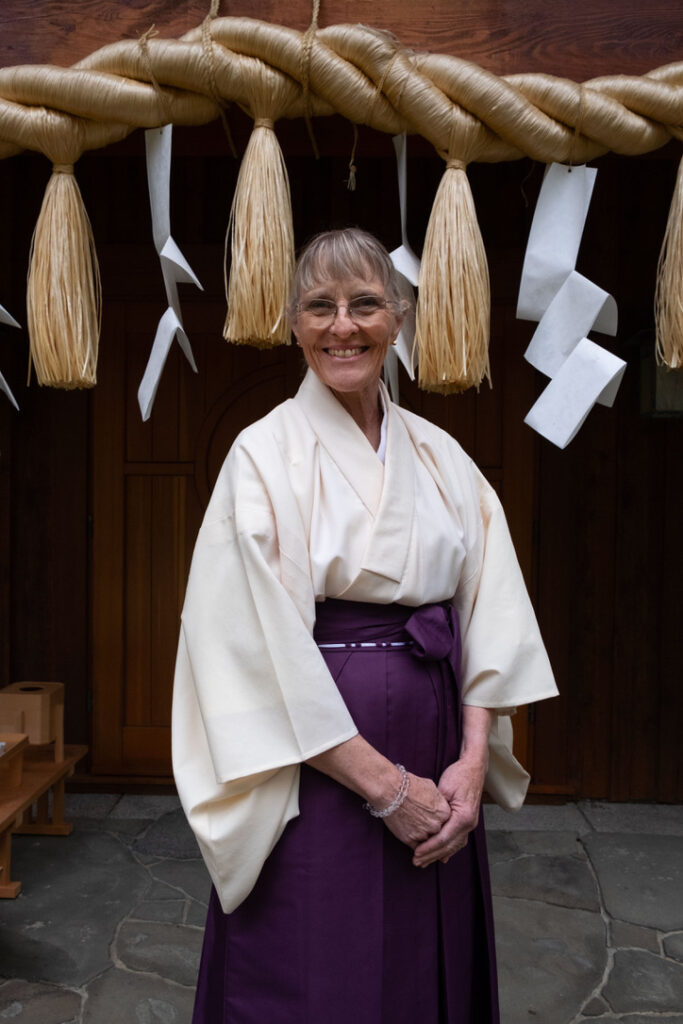
Rev. Ann Evans is a Shinto priest and is the Guji, High Priest, of Tsubaki Grand Shrine North America. She is the founder of Matsuri Foundation of Canada.
She has studied for 25 years under the tutelage of the Chief Priests of Tsubaki Grand Shrine in Japan; Guji Yukitaka Yamamato was the 96th generation priest in his family. His son, Guji Yukiyasu Yamamoto continues the tradition and serves on the Board of Directors of Matsuri Foundation.
She teaches Shinto practice and principles as a way of finding joy and brightness in our daily lives. She has authored Shinto Norito: A Book of Prayers which provides western readers with a romanized pronunciation of the Japanese prayers as well as a translation.
She is also a certified ANFT Forest Therapy Guide based the tradition of Shinrin Yoku, or Forest Bathing—a guided practice leading us to awaken our senses.
In the setting of the Forest, we can quiet our mind and find a deepened connection with Great Nature and our selves. Your guide will take you through a structured experience with a sequence of invitations. Moments of silence, meditation, solitude and sharing build a rich experience where the Forest is the therapist, and the guide opens the door.
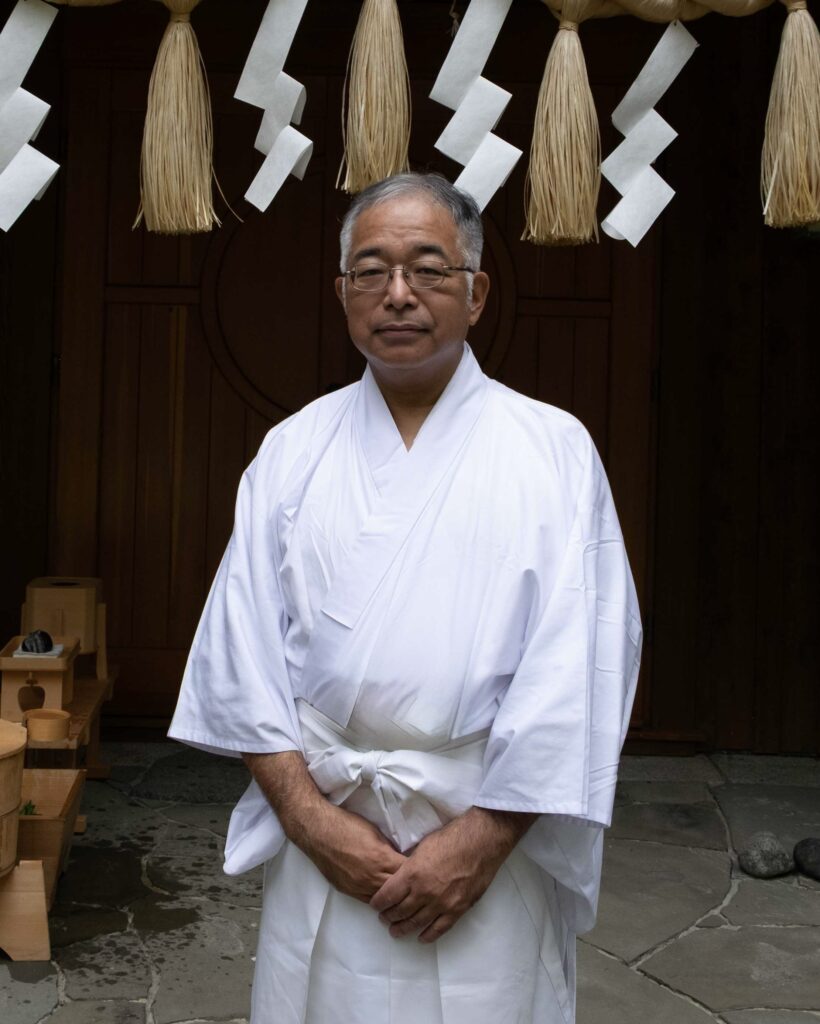
Rev. Kotaro Matsuzawa
Matsuzawa Sensei brings long experience in the Shinto priesthood and a broad view of the world. He has served at two of Japan’s most important shrines. He has served as a priest at Nikkō Tōshōgū and at Kawagoe Hachimangū.
Nikkō Tōshōgū, founded in 1617, enshrines Tokugawa Ieyasu, who founded the shogunate that brought Japan more than 250 years of peace. Kawagoe Hachimangū was founded over 1000 years ago, venerating Hachiman, one of the most widely worshipped kami in Japan.
From 2004 to 2023, he served with Japan’s Ministry of Foreign Affairs, with postings that included Honolulu, Chicago, and other locations. He also holds a Doctor of Laws (LL.D.). His nearly twenty years of diplomatic service gave him an understanding of many cultures and a respect for the ways people of different backgrounds look for meaning and connection.
His two careers come together in his view of Shinto as a path to peace, both within each person and between peoples. Through harae, the purification of the heart, and through living with makoto, a sincere and honest spirit, each of us can restore our natural harmony with the kami, with nature, and with one another. In his own words: “As the way of the kami continues to reveal itself to me, I have come to see Shinto as a path to recognize the kami in all of Great Nature, to purify myself so that my innate brightness can shine, and to live each day with gratitude. When this brightness is restored within me, I hope it will spread outward as harmony and peace.”
Matsuzawa Sensei is fluent in Japanese and English, so he can welcome every visitor to the shrine. He explains Shinto practice clearly and warmly, whether you are a longtime follower or encountering the kami for the first time.
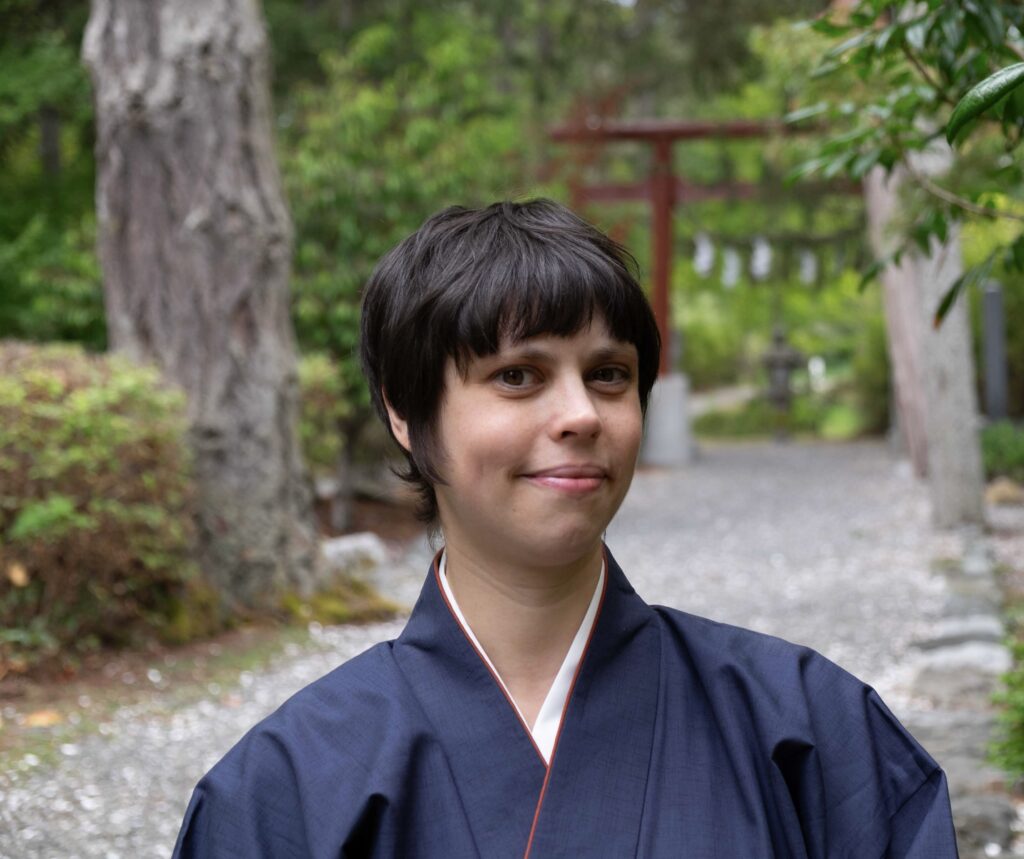
Kate Romain
Kate serves as a Shrine Assistant and brings a deep love of Shinto, nature, art, and music to her work at the shrine.
For Kate, Shinto is a foundational path, one that shapes how she sees the world and her place within it. That sense of connection to the kami, to the natural world, and to the beauty found in creative expression comes through in everything she does.
Visitors to the shrine will often be greeted by Kate, who takes care to make everyone feel welcome, whether it is their first visit or their hundredth.
She helps with ceremonies held at the shrine and behind the scenes, she helps organize shrine events and supports our volunteers, making sure that each gathering runs smoothly and that those who give their time feel valued.
Her warmth and dedication are a gift to our community.